Most minimalist rooms fail the same way: they photograph beautifully and feel like a waiting room. The fix isn't more stuff. It's warmer choices inside the same restraint. Warm minimalism (you'll also see it called japandi when it leans Japanese-Scandinavian) keeps the clear surfaces and the breathing room, but swaps stark white for soft beige, chrome for oak, and gloss for linen. The result is a living room that stays calm without going cold.
Swap the palette, keep the restraint
Cold minimalism is usually a color problem, not a furniture problem. Pure white walls under daylight bulbs read as clinical no matter how beautiful the sofa is. Shift every neutral one step warmer: cream instead of white, greige instead of grey, warm oak instead of black or chrome. You keep the quiet, uncluttered feeling, but the room now flatters skin tones and evening light instead of fighting them. If you only change one thing, change the whites.
Spend your object budget on texture
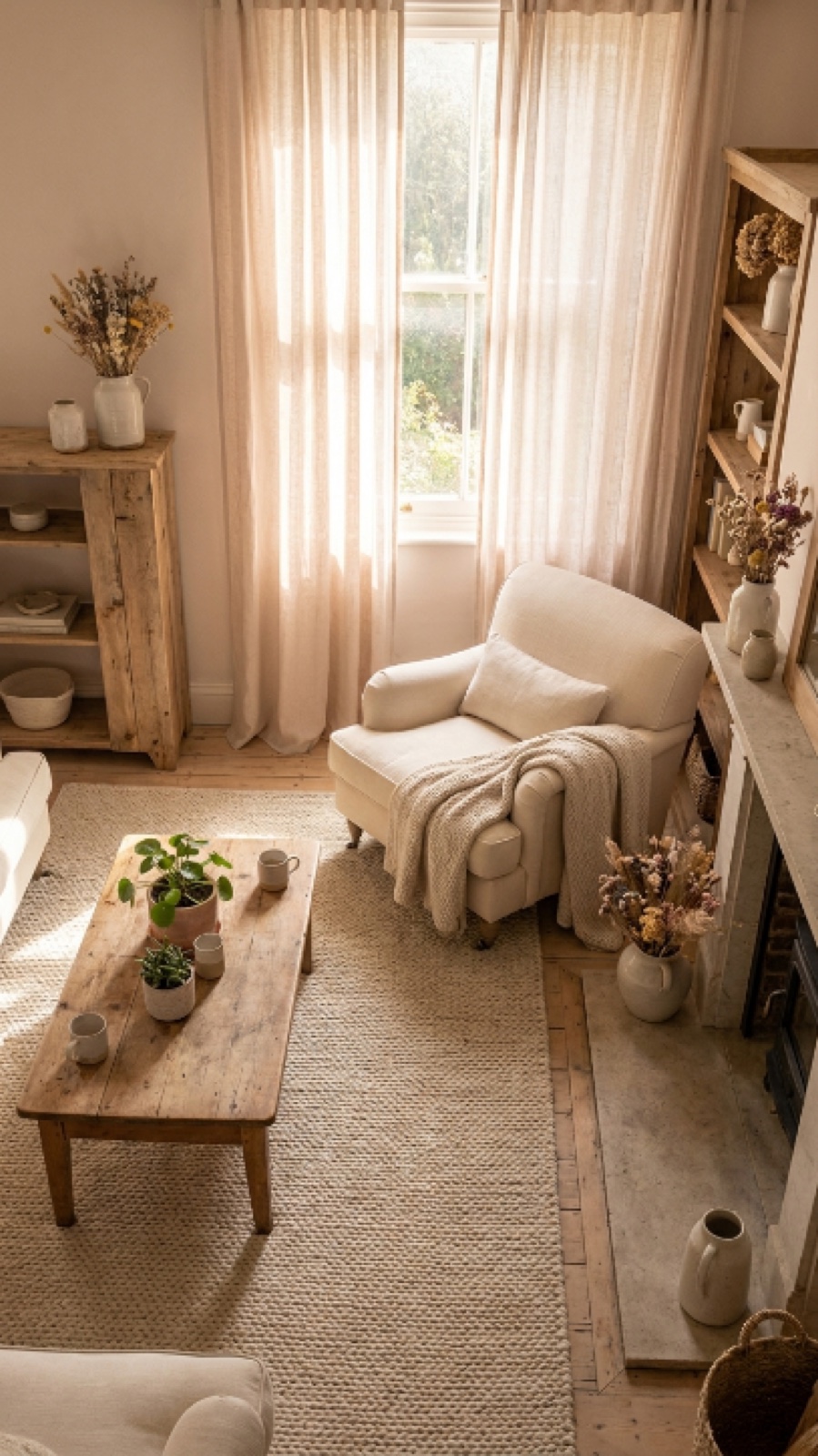
A minimalist room has few things in it, so each thing has to work harder. Texture is how a spare room avoids feeling flat: a nubby linen sofa, a chunky wool rug, a knitted throw folded over one arm. Aim for at least three different textures you can name from the doorway, like boucle, raw wood and stone. The rule of thumb: if every surface in the room is smooth, it will feel cold at any temperature.
Let wood do the warming
Wood is the single most reliable warmth signal a room can send. In a pared-back space, a solid oak coffee table or a simple pine shelf does what a dozen accessories would do in a maximalist one. Keep the tones light-to-medium (honey, natural oak, ash) and repeat the same wood family two or three times around the room so it reads as intentional rather than leftover.
Filter the light with sheer linen
Bare windows belong to showrooms. A single pair of semi-sheer linen curtains softens incoming daylight into the kind of glow that makes plaster walls look expensive, and they add vertical texture without adding visual noise. Hang them high and let them just kiss the floor. In the evening, skip the ceiling light entirely. One warm lamp at seated eye level keeps the calm mood the daylight started.
Treat empty space as the luxury
The point of minimalism is that emptiness itself feels good, but only when it's framed. An empty corner next to a beautifully made-up sofa reads as calm; an empty room reads as unfinished. Style one small vignette (a vase, a stack of two books, a candle) and then deliberately leave the surfaces around it clear. That contrast between one considered moment and quiet space around it is what people mean by 'expensive-looking'.
Add life that doesn't shout
Dried flowers, a single branch in a stoneware vase, or one healthy green plant give a minimal room the pulse it needs. Dried botanicals suit the style especially well: their muted browns and creams sit inside the palette instead of on top of it, and they ask nothing of you. One or two living or once-living things per room is enough; a shelf full of them is a different (also lovely) style.
Keep it livable, not staged
The warm in warm minimalism is ultimately about permission: the throw is allowed to be rumpled, the book is allowed to sit open on the table. Build in one honest comfort zone (a deep chair with a blanket in reach) and let it look used. A minimal room you're afraid to sit in has failed at its only job. Calm is the goal; empty is just the method.